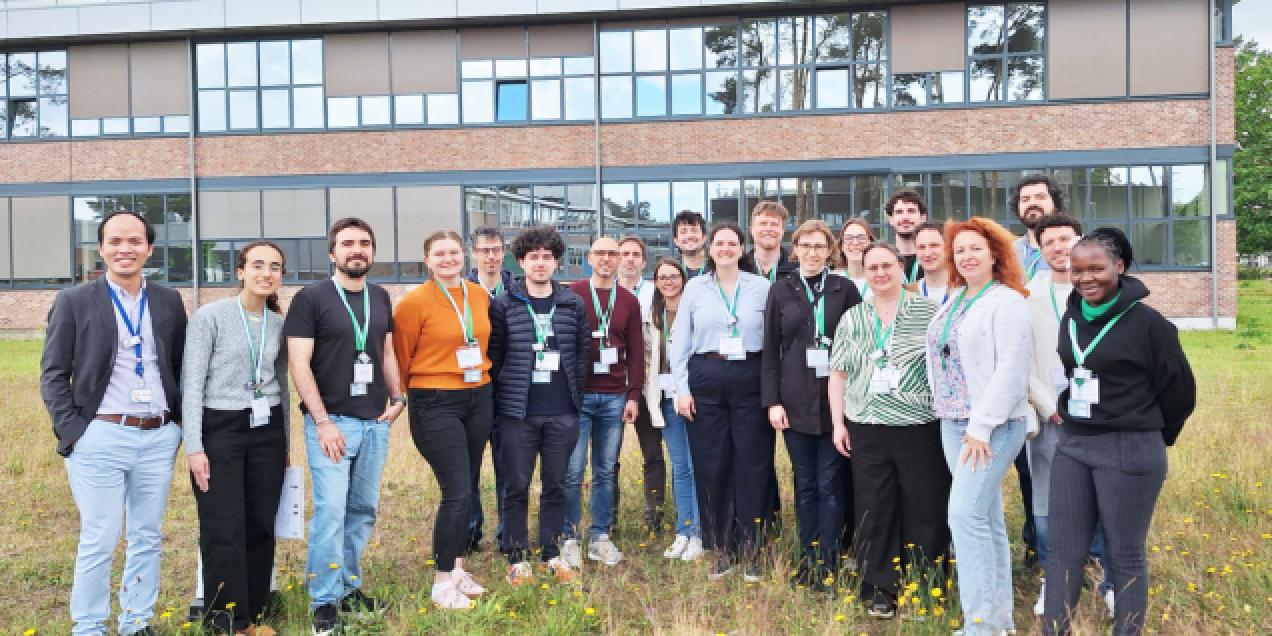
STAB-SLAK Project investigates compatibility of slag from plasma incineration of waste for surface disposal
Are plasma slags sufficiently stable and compatible with surface disposal? That is the central question the STAB-SLAK project set out to answer. SCK CEN and ONDRAF/NIRAS have successfully concluded the STAB-SLAK project, a five-year research initiative funded by the Energy Transition Fund of the federal government service Economy that explored the long-term stability of plasma slag – the end-product resulting from the application of plasma incineration technology for the (re)conditioning of radioactive waste – as a function of its chemical composition. This collaboration marks an important milestone in Belgium’s radioactive waste management programme.

SCK CEN’s role: expertise and infrastructure
SCK CEN’s Waste & Disposal Expert Group played a central role in this project, leveraging its state-of-the-art infrastructure and deep expertise in radioactive waste characterization and treatment. Their contributions were instrumental in generating reliable data and advancing the scientific understanding of plasma slag behavior. SCK CEN: A Trusted Partner in Waste Research.
Do you have a radioactive waste project in mind? Want to get in touch with our Waste&Disposal experts? Use the contact form below.

Studying plasma slags for surface disposal
Plasma slag, a Glass Composite Material (GCM), is the solidified residue resulting from the very high-temperature treatment of radioactive waste using a combination of plasma technology and a vitrification bath. The suitability of the slag for surface disposal depends on its chemical and physical behavior in cementitious – and thus alkaline – environments, which will be omnipresent in such a repository.
The STAB-SLAK project aimed to identify the key parameters that influence the long-term stability of these GCM’s in such a repository. Together with ONDRAF/NIRAS, our research team produced and tested a wide range of slag samples with varying chemical composition. These samples underwent leaching and expansion tests, in conditions close to those they would face in a surface disposal facility. To speed up the processes, tests were done at higher temperatures than those expected in this disposal facility.
🔗Check out our dedicated page on plasma technology for waste conditioning.

A rigorous scientific approach
GCM’s with widely differing chemical composition can be produced from various types of waste streams. The first step to ensure comprehensive results was thus to define the types of waste which might benefit from a plasma treatment. Based on this, a list was compiled of the chemical elements that might be present in the plasma slag, along with their minimum and maximum concentrations. ONDRAF/NIRAS then designed an experiment using this list, systematically varying the critical components in the GCM while keeping the number of slags to be tested to a minimum. Moreover, the cooling rate was also included as a technical or process parameter, since slower cooling promotes crystallization, which might affect the stability of the GCM. Leaching and expansion tests were conducted and meticulously analysed. The outcome is a robust dataset that supports decision-making with respect to the future of this technology for the Belgian radioactive waste management programme.
How were these slags produced?
The project team collaborated with InsPyro N.V. to produce 30 different GCM’s. These were produced by melting mixtures of oxides, which represented waste components and fluxes, at high temperatures in zirconia crucibles.
Two different cooling regimes were applied:
- Fast cooling: simulating the outer layers of a waste drum.
- Slow cooling: mimicking the centre of a large waste package, where heat dissipates more slowly.
The result was a diverse set of GCM’s, each with a unique combination of amorphous and crystalline phases, covering a 15-dimensional space. These differences in composition and structure were key in understanding how slags behave under conditions that simulate those expected in the surface disposal site.

How did we test the GCM samples?
SCK CEN’s R&D Waste Packages research unit (RDW) led the experimental programme, using its unique infrastructure to conduct a wide range of tests:
1. Leaching tests
Leaching tests or dissolution tests aim to estimate the rate and mechanism at which a sample releases its constitutional compounds. To simulate the chemical environment of a surface disposal site, GCM samples with a grain diameter of 1–2 mm were immersed in cement pore water (IPM water) with a pH of 12.5 and a temperature of 40 °C. Three types of tests were carried out to gain an understanding of the samples’ dissolution behaviour in the short and long term:
- Static tests: GCM samples were left in contact with the solution for 91 days, with periodic sampling.
- Semi-dynamic tests: In these long-term static tests the solution was replaced every 91 days whilst the periodic sampling scheme was maintained.
- Dynamic tests: A flow of solution passed slowly and continuously over the slag and the solution was regularly sampled to monitor the continuous evolution of the dissolution rate with time.
Elemental concentrations (e.g. Si, Al, Pb, B, Cu) were measured using by SCK CEN experts from the radiochemical analysis group using ICP-AES, ICP-MS and ion chromatography. RDW carried out the measurement of the Si monomer concentration using UV/Visible spectrophotometry.
2. Testing volumetric stability
GCM’s ground into granules were mixed with cement and water and cured at 20 °C to form prisms. The length change of the prisms stored under high humidity and a temperature of 60 °C was monitored over 120 days. Monitoring the expansion made it possible to assess whether the GCMs could cause swelling and cracking in alkaline disposal conditions.
3. Microstructural analysis
Using SEM-EDX and XRD, researchers examined the internal structure of the GCM’s before and after leaching. This indicated how different phases dissolved, altered, or precipitated over time, which contributed to the understanding of the dissolution behaviour of the GCM samples. SEM-EDX is also applied to scan the cement-slag granulate mixtures after the 120-day expansion test to identify a potential underlying mechanism explaining the observed behaviour.
4. Mechanical strength
Another way to assess whether detrimental processes occur during the expansion tests in the cured cement-slag granulate mixtures, is to measure the flexural and compressive strength of the prisms at the end of the expansion test. A strong change of the values of these parameters could indicate an interaction of the slag in close contact with cement.
What did we learn?
-
Elements like boron and lead leached more readily, silicium, aluminium and chromium leached at an intermediate rate, while iron and nickel did leach very slowly. Overall, the observed elements could be classified as fast-, intermediate- and slow-leaching.
-
Slower cooling rates are generally expected to increase crystallinity in the sample, which can lead to variations in leaching behaviour – even among samples with identical compositions. However, for the STAB-SLAK samples, no significant relationship between cooling rate and leaching behaviour was observed.
-
This is important for long-term radiological safety, as Nb is a key contributor, for some waste streams, to the dose received by humans.
-
Furthermore, the flexural and compressive strengths of the prisms remained very high at the end of the volumetric stability tests. These parameters were not affected by the dissolution behaviour of the slag in contact with cement.
🔗 In-depth reporting and technical details can be found here:
What’s next?
The first phase of STAB-SLAK concluded in 2025, but the work continues. A follow-up project, STAB-SLAK 2.0, funded by ONDRAF/NIRAS, is already underway. It will:
- Extend semi-dynamic and dynamic tests to confirm long-term trends.
- Include additional semi-dynamic tests on Nb-containing slags.
- Refine the predictive models so that they can be used in assessments of the applicability of plasma technology.
A milestone for Belgium’s waste programme
The STAB-SLAK project has laid the groundwork for confidently assessing the long-term stability of plasma slags in surface disposal conditions. Thanks to the combined expertise of SCK CEN and ONDRAF/NIRAS, significant progress has been made towards understanding this behaviour under realistic disposal conditions.
SCK CEN has once again proven its role as a cornerstone of Belgium’s radioactive waste management programme. This achievement underscores SCK CEN’s indispensable role in supporting national efforts toward safe and sustainable waste management, and the value of close cooperation with ONDRAF/NIRAS.