
PhD Defense | Daniel Stein | Electrochemical Oxygen Pumping as an In-Situ Probe for Corrosion in Liquid Lead: Validation of the Method and Investigation of Dissolved Fe and Ni Effects on 316L Stainless Steel
Name: Daniel Dietrich Stein
Date: 9 November 2026 - 16:00h
Research output: https://researchportal.sckcen.be/en/persons/daniel-stein/publications/
Location:
VUB Etterbeek Campus Room D.2.01
Teams link for online participation:
https://teams.microsoft.com/meet/3439318171753689?p=qvsw5hb7N8rjicbtlQ
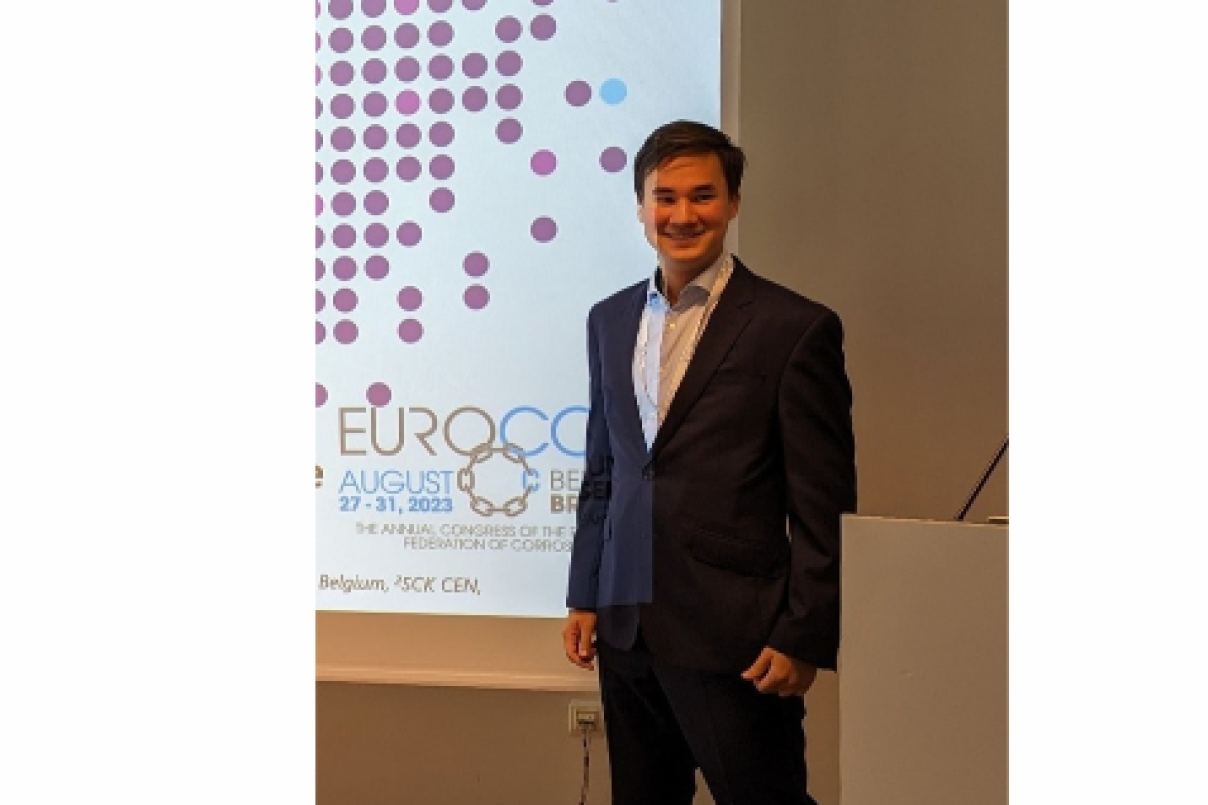
Electrochemical Oxygen Pumping as an In-Situ Probe for Corrosion in Liquid Lead: Validation of the Method and Investigation of Dissolved Fe and Ni Effects on 316L Stainless Steel
Liquid lead can be used as a heat transfer fluid in advanced nuclear reactors. However, the steel components in contact with this coolant must withstand high temperatures and corrosion over long periods. Stainless steel 316L is a candidate material for these components, but some of its constituent elements, iron, chromium and nickel, can dissolve into liquid lead, progressively damaging the steel. Understanding how the chemical composition of the coolant affects this process is therefore essential for developing reliable reactor systems.
This thesis investigates ways to monitor corrosion during exposure and examines how controlling the amounts of oxygen, iron, and nickel dissolved in liquid lead can help reduce steel degradation. A central part of the work explores an electrochemical oxygen pump, a device that controls and measures the oxygen supplied to the liquid metal.
The device was first assessed as a tool to identify whether reactions occurred at the surface or involved metal that had dissolved into the lead. The results indicated that the oxygen consumption rate acted as a proxy for when dissolution corrosion was occurring. The measurements also provided rough estimates of the amount of dissolved material. This demonstrates the potential of the oxygen pump to provide information during exposure, complementing examinations performed after a test.
Experiments on stainless steel 316L at 500 °C showed that dissolved iron and nickel strongly influence corrosion. Increasing the iron content of the lead reduced the proportion of the steel surface affected by dissolution. Adding nickel had a stronger effect, suppressing the loss of elements from the steel and promoting the formation of a surface oxide layer. Nickel additions also reduced oxygen consumption, suggesting that limiting nickel loss helps reduce the dissolution of iron and chromium.
Overall, this research shows that monitoring oxygen consumption can offer useful insights into corrosion and that controlling dissolved metallic elements provides a promising way to limit steel degradation. These findings support the development of coolant chemistry strategies to improve the durability of components in future lead-cooled nuclear reactors.
Promoter:
Iris De Graeve, Sustainable Materials Engineering, VUB
SCK CEN mentors:
Alessandro Marino, CCR
Serguei Gavrilov, SMA